
Caesarea is one of Israel’s best-kept secrets — and one of its most remarkable destinations. Built by Herod the Great two thousand years ago as the most ambitious construction project of the ancient world, the city was a Roman capital, a Crusader fortress, and a Byzantine port before it was abandoned to the sea. Today it has been reborn as one of Israel’s most exclusive residential communities and most extraordinary visitor experiences: a place where you can swim in the Mediterranean in the morning, walk through a Roman amphitheatre in the afternoon, and dine at a waterfront restaurant in the evening, all within a few hundred metres of each other.
For visitors seeking short term rentals in Caesarea, this guide covers everything — from the town’s extraordinary history to the practicalities of staying here, and why this small stretch of Mediterranean coastline offers one of the most distinctive experiences available anywhere in Israel.
Why Caesarea?
Most visitors to Israel focus their itineraries on the obvious anchors — Tel Aviv, Jerusalem, the Dead Sea. Caesarea rarely makes it onto the standard first-time itinerary, which is precisely what makes it so rewarding for those who discover it. For a full country overview, see our complete guide to traveling in Israel.
The town sits on the Mediterranean coast roughly halfway between Tel Aviv and Haifa, about 50 kilometres north of Tel Aviv. It is small — the resident population of the modern town numbers only a few thousand — but what it offers is extraordinary. The Caesarea National Park encompasses one of the most impressive archaeological sites in the Middle East: a Roman harbour, an amphitheatre that still hosts concerts, a hippodrome, Crusader fortifications, Byzantine mosaics, and the remains of Herod’s palace, all set directly on the Mediterranean coast.
Beyond the archaeology, Caesarea has developed over the past two decades into one of Israel’s most desirable residential communities. The modern town — built adjacent to the ancient site — is immaculately maintained, leafy, and home to a significant number of Israel’s most successful business and cultural figures. The infrastructure that comes with this — the restaurants, the galleries, the golf course, the marina — is of a consistently high standard.
For visitors, the combination of extraordinary history, Mediterranean beauty, excellent food, and a calm, unhurried atmosphere makes Caesarea one of the most pleasurable places to spend a few days in Israel.
The History You Are Walking Through
Understanding what Caesarea was helps you understand why visiting it feels so different from other historical sites. This was not a minor Roman outpost — it was one of the most important cities in the eastern Mediterranean for over a thousand years.
Herod’s Vision
Around 22 BCE, Herod the Great — the same ruler who built the expansion of the Temple Mount in Jerusalem — undertook the construction of an entirely new city on the Mediterranean coast. There was no natural harbour here; Herod created one from scratch, using an innovative technique of pouring hydraulic concrete underwater to build the harbour walls. The resulting port, called Sebastos (the Greek translation of Augustus, to whom the city was dedicated), was one of the largest artificial harbours in the ancient world.
The city Herod built around this harbour was designed to impress. A vast amphitheatre capable of seating 10,000 spectators. A hippodrome for chariot racing. A temple to Augustus and Roma on a raised platform visible from the sea. Paved streets on a Roman grid. A sophisticated sewage system flushed by tidal action. By any measure, it was an extraordinary achievement.
Roman Capital and Early Christianity
Under Roman rule, Caesarea became the administrative capital of the province of Judaea — the seat of the Roman prefects, including Pontius Pilate, whose name was found inscribed on a stone here in 1961, the first archaeological evidence of his existence. The Apostle Paul was held prisoner in Caesarea before being sent to Rome. The city’s diverse population — Jews, pagans, and an early Christian community — made it one of the most cosmopolitan cities of the ancient world.
Crusader Fortifications
After the Arab conquest in the 7th century and centuries of shifting control, Crusader forces captured Caesarea in the 12th century and constructed the fortifications whose walls still stand today — great stone ramparts rising directly from the sea, enclosing the area around the ancient harbour. The Crusader city was smaller than the Roman one but built with equal ambition, and the walls, moat, and gates that remain are among the best-preserved Crusader fortifications in Israel.
Abandonment and Rediscovery
The Mamluk sultan Baybars destroyed Caesarea in 1265 to prevent it falling back into Crusader hands, and the city was abandoned. For centuries, its ruins lay half-buried in sand dunes on the Mediterranean coast. Modern excavations, which continue to this day, have progressively revealed the extraordinary extent of what was left beneath the surface.
What to See and Do in Caesarea
Caesarea National Park
The National Park is the centrepiece of a visit and should be allocated a minimum of three to four hours — more if you want to do it properly. The site is large and intelligently laid out, with excavated areas connected by walkways and signposted in English throughout.
The Roman amphitheatre is perhaps the most immediately impressive structure: a horseshoe of stone tiers stepping down to a stage backed by the Mediterranean. It is still used for concerts and performances — attending an outdoor concert here is an experience unlike almost anything else available in Israel. The acoustics are extraordinary, and the setting, as the sun goes down over the sea behind the stage, is genuinely breathtaking.
The ancient harbour area allows you to walk along the original Roman quayside and look out over the foundations of Sebastos — the artificial harbour walls are still partially visible beneath the water. The remains of the temple platform stand at the centre of what is now an open plaza, with the sea on three sides.
The Crusader fortifications — accessible via a drawbridge over the original moat — enclose a compact area of excavated streets, arches, and columns that gives a vivid sense of the medieval city within the Roman one.
The Marina and Waterfront
The modern marina, built within and around the ancient harbour area, is one of the most atmospheric in Israel. The restaurants and cafés that line the waterfront — many with outdoor terraces overlooking the archaeological site — range from excellent casual seafood to genuinely sophisticated dining.
The waterfront is where Caesarea’s modern identity is most visible: well-heeled, beautifully maintained, and aware of its own distinctiveness. It is a pleasure to walk, sit, and eat here at any time of day.
Golf
The Caesarea Golf Club, one of only a handful of golf courses in Israel, is a full 18-hole championship course set in beautifully landscaped grounds between the town and the sea. For visiting golfers, playing a round here — with the Mediterranean visible from several holes — is a genuinely memorable experience. The course is open to visitors and equipment rental is available.
Beaches
Caesarea’s beaches are among the most beautiful on the Israeli Mediterranean coast. The combination of clear water, sandy shoreline, and the extraordinary backdrop of ancient ruins makes swimming here unlike almost anywhere else. The beach adjacent to the National Park, where Roman columns protrude from the sand at the waterline, is particularly striking. For a full overview of the country’s coastline, see our guide to the best beaches in Israel.
Aqueduct Beach
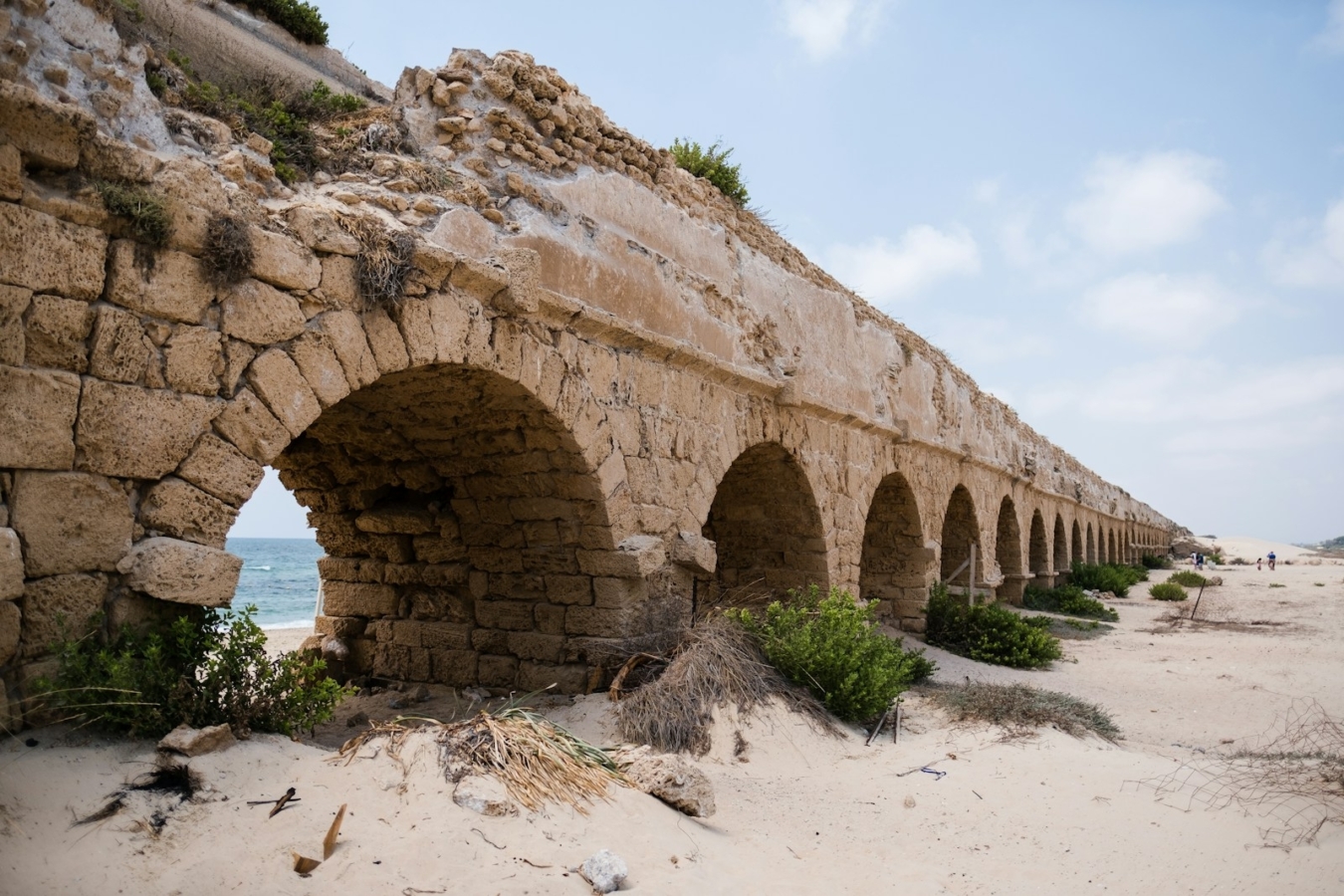
North of the main town, the Roman aqueduct that once brought fresh water from Mount Carmel to the city emerges at the coastline and runs parallel to the beach for several hundred metres before disappearing into the sand. This stretch of beach — the aqueduct on one side, the Mediterranean on the other — is one of the most photogenic spots in Israel and one of the most unusual swimming environments in the world.
Cycling
A well-maintained cycling path connects the main archaeological site, the marina, the beaches, and the surrounding countryside. Cycling is an excellent way to cover the dispersed attractions of Caesarea at a comfortable pace. Bike rental is available near the National Park entrance.
Staying in Caesarea: Why Short Term Rentals
Caesarea has very limited hotel infrastructure — there is one significant hotel property in the town, and it is expensive. For visitors who want to spend more than a day here, short term rentals are not just the best option — they are essentially the only practical one.
Access to a Remarkable Town
Caesarea’s residential community is one of the most beautiful in Israel — quiet, tree-lined streets, well-maintained gardens, and a general sense of order and quality that reflects the town’s distinctive character. Staying in a short term rental here means waking up in this environment, which is a genuinely different experience from staying in a hotel in a larger city and making a day trip.
Proximity to the Site
Many of Caesarea’s short term rental properties are within easy walking distance of the National Park, the marina, and the beaches. The ability to visit the archaeological site in the early morning — before the day-trip crowds arrive — and return again in the late afternoon when the light is at its most beautiful is one of the great advantages of basing yourself here.
Base for the Region
Caesarea’s central position on the coast makes it an excellent base for exploring a wider region. Tel Aviv is 45 minutes to the south; Haifa and the Bahá’í Gardens are 35 minutes to the north; the Carmel wine region is 30 minutes inland; and Akko (Acre), one of the best-preserved Crusader cities in the world, is an hour to the north. A short term rental in Caesarea allows you to explore all of these while returning each evening to one of the most pleasant towns in the country.
Space for Families
Caesarea is one of Israel’s most family-friendly destinations. The National Park is engaging for children of all ages, the beaches are clean and safe, the marina area has good restaurants with outdoor seating, and the cycling paths are ideal for family rides. A short term rental with multiple bedrooms and outdoor space transforms a visit here from a day trip into a proper holiday.
Short Term Rentals in Caesarea with KeyHost
KeyHost’s portfolio in Caesarea reflects the town’s distinctive character — properties selected for quality, setting, and proximity to the site and the sea. Every KeyHost property in Caesarea is professionally managed, with concierge service that can arrange National Park tickets, restaurant reservations, golf tee times, and guided archaeological tours.
The KeyHost team has detailed knowledge of Caesarea and the surrounding region, and this knowledge is available to every guest: the best time to visit the amphitheatre, the quietest beach sections, the restaurants that justify the short drive north towards Haifa, and the seasonal concert schedule at the ancient theatre.
Explore our Caesarea properties at keyhost.online.
Practical Information
Getting to Caesarea
By car: Caesarea is located on Route 2 (the coastal highway), approximately 50 kilometres north of Tel Aviv and 40 kilometres south of Haifa. The drive from Tel Aviv takes around 45 minutes without traffic. A car is strongly recommended — the town is spread out and public transport is limited.
By train: The Binyamina station, served by Israel Railways, is approximately 5 kilometres from Caesarea. Trains run from Tel Aviv and Haifa regularly. Taxis and some local transport connect the station to the town, but a car is more practical for exploring the full site.
By bus: Limited bus services connect Caesarea with Tel Aviv and Haifa. The bus is workable for a day trip but less practical for a stay with luggage and flexible itinerary.
Opening Hours and Tickets
The Caesarea National Park is open daily. Tickets can be purchased at the entrance or online in advance (recommended during peak periods). The price includes access to all areas of the site. An audio guide in multiple languages is available.
When to Visit
Caesarea is excellent year-round. Summer is hot (30–33°C) but the sea is perfect for swimming and the evening concert season at the amphitheatre is in full swing. Spring and autumn offer the most comfortable conditions for extended sightseeing. Winter is mild and the site is at its quietest — the archaeological areas are particularly atmospheric on a cool, overcast day.
The main festival season — when the amphitheatre hosts major concerts and international performers — runs from May through September. If attending a concert here is part of your plan, check the schedule at the Caesarea Amphitheatre website and book tickets well in advance.
For a complete overview of what to see, eat, and do in Caesarea, download our free Caesarea guide.
Frequently Asked Questions
How long do I need to visit Caesarea? A day trip allows you to see the highlights of the National Park and the marina. Two to three nights as a base allows you to explore the site properly, visit the nearby aqueduct beach, take day trips to Haifa and the Carmel region, and experience the town at its best in the early morning and evening.
Can I swim at the ruins? Yes. The beach adjacent to the National Park — where Roman columns emerge from the sand — is one of the most extraordinary swimming locations in Israel. The water is clean and clear.
Is Caesarea suitable for families with young children? Very much so. The National Park is engaging and accessible, the beaches are safe and well-supervised, and the marina area has child-friendly restaurants. The cycling paths are excellent for family rides.
Are there restaurants in Caesarea? Yes, and they are good. The marina area has several excellent restaurants ranging from casual seafood to more sophisticated dining. The quality of food in Caesarea is consistently high — the town’s affluent resident population ensures strong competition among its restaurants.
Is Caesarea expensive? Caesarea has a reputation as one of Israel’s more expensive destinations. Restaurant prices at the marina are higher than in Tel Aviv. Short term rentals, however, offer good value compared to the town’s limited hotel options, particularly for families or groups.
What else is near Caesarea? Within easy driving distance: Tel Aviv (45 min south), Haifa and the Bahá’í Gardens (35 min north), the Carmel wine region (30 min east), Akko/Acre (1 hr north), Megiddo/Armageddon (45 min east), and Zichron Ya’akov, a charming wine village (20 min south). For a broader perspective, our Tel Aviv vs Eilat comparison can also help you position Caesarea in your itinerary.
Final Thoughts
Caesarea is one of the most genuinely surprising places in Israel — a town that manages to be both archaeologically overwhelming and deeply pleasant to spend time in. The combination of a world-class ancient site, a beautiful Mediterranean coastline, excellent food, and a calm, well-maintained residential character makes it unlike anywhere else in the country.
Short term rentals give you the time to experience it properly: the early morning light on the Roman stones, the amphitheatre at sunset, the aqueduct beach at low tide. These are experiences that reward staying rather than passing through.
For premium short term rentals in Caesarea, explore the KeyHost portfolio at keyhost.online.
